Hairdressing Apprenticeship Guide: Everything you Need to Know
 Kristen Michaelides

Becoming a hairdresser in Australia is a great career choice. If you’ve got an eye for detail, you’re outgoing and friendly, and you love to work with your hands, you’ll definitely thrive as a hairdresser.
The road to becoming a hairdresser in Australia is a little bit complicated, but this guide takes you through the entire process. It will give you insights on:
- How to become a hairdresser in Australia
- How to get a hairdressing apprenticeship
- Hairdressing apprenticeship information
This guide also explores the hairdressing industry and offers insights into where your career can take you.
You can be any age to start an apprenticeship and there are plenty of mature age apprentices out there.
Hairdressing is a large, steady business in Australia that’s currently employing over 59,100 people. The majority of these workers are female (85%) in the 25-34 age bracket.
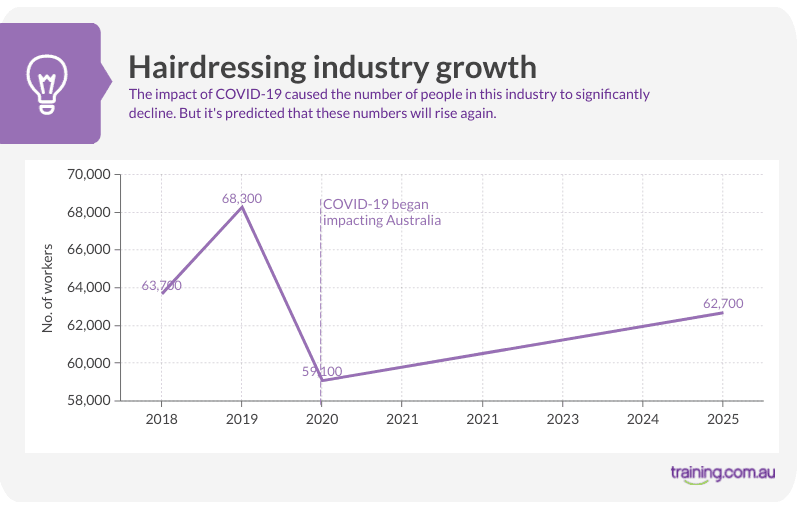
Hairdressing also offers both full-time and part-time work opportunities. Just under 50% of current hairdressing professionals work part-time hours, allowing plenty of time for other life commitments while still building a career!
How to become a hairdresser in Australia
Find a salon to employ you as an apprentice.
This will likely be the biggest hurdle to becoming a hairdresser, but you’ll be able to find an employer with a little persistence. If there’s a salon you’re passionate about working in, approach them directly and explain why you’d like to work there and what you can offer them — think of it as an on-the-spot job interview.
If you’re not fussy about which salon you complete your apprenticeship at, you can ask enrol in a course first and ask the RTO you’re studying with to source a salon to employ you.
Enrol in your chosen hairdressing qualification.
This is commonly a Certificate III in Hairdressing (SHB30416), and it must be completed with an RTO. The salon you work for may specify their preferred RTO. A hairdressing apprenticeship can take three to four years to complete.
Alternatively, you could complete the Cert III in Hairdressing alone, which will take one year of full-time study. But this may not be the best way to study, as you won’t gain the practical experience that salons are looking for in junior stylists.
Get a job as a junior stylist and progress your career.
Once you’ve completed your apprenticeship or Cert III, you’ll be a fully qualified hairdresser. You’ll be able to get a job in the industry with the title, “Junior Stylist” (pretty schmick). And from there, you’ll continue to gain mentorship from senior stylists and work your way up.
What qualifications do you need to be a hairdresser?
A hairdresser’s education is important because it creates a foundation for the practical and theoretical skills they’ll use for the rest of their career.
To become a fully qualified hairdresser, you must complete a hairdressing apprenticeship or at least hold a Cert III in Hairdressing. The good news is that there are minimal requirements for beginning your apprenticeship. You only have to be over 16 and have a minimum completion of Year 10 Literacy. If you don’t have this Year 10 Literacy pre-requisite, you can apply to study a VCAL Hair and Beauty course alongside your Year 10 studies at school. The Certificate II in Salon Assistance (SHB20216) is a great option for you!
A hairdressing apprenticeship allows you to study the technical aspects of hairdressing and give you hands-on work experience to put those skills into practice in a professional environment.
To get your first hairdressing apprenticeship, you’ll need to find a salon that will take you on as an apprentice. You’ll need to enrol in a Certificate III in Hairdressing (SHB30416) with an RTO, and the salon may specify their preferred RTO.
When it comes to studying hairdressing, there are a variety of qualifications available. They all stack together to offer a well-rounded learning experience.
This is the order hairdressing qualifications stack together in Australia:
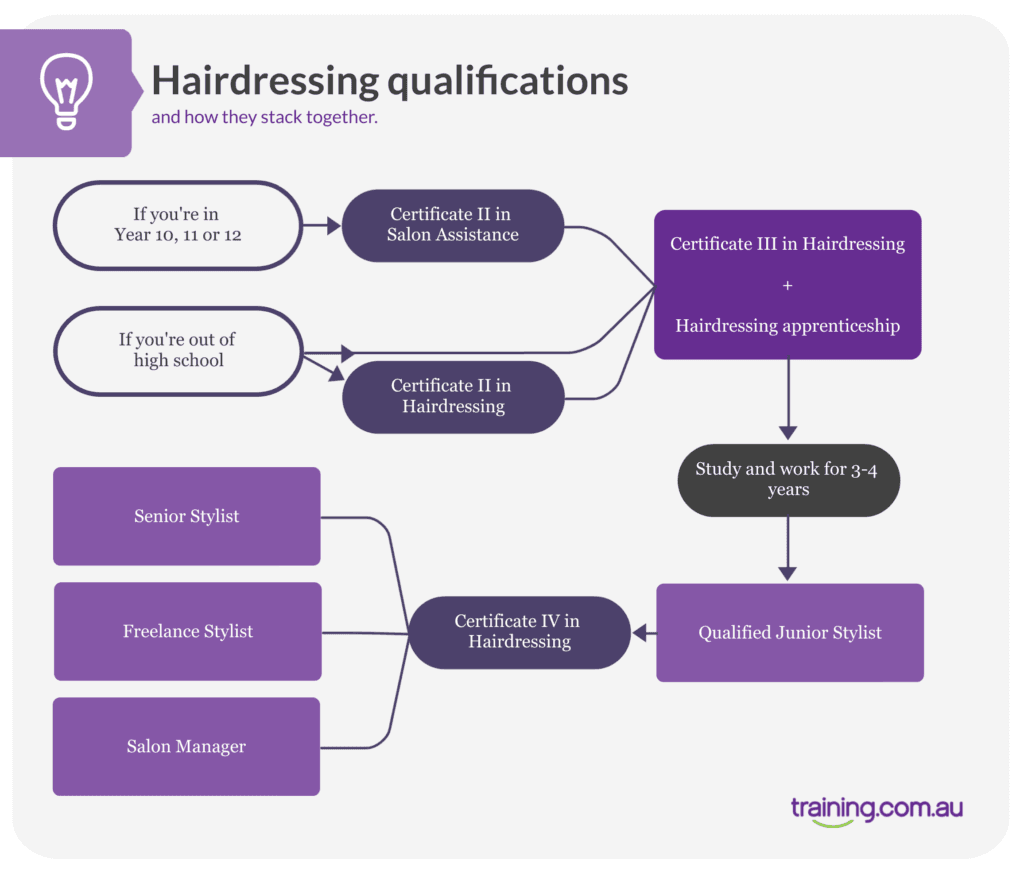
Certificate II in Hairdressing (SIH20111)
Will allow you to work as a salon assistant on a hairdressing team.
This qualification is an introduction to working as a hairdresser and the industry in general. This qualification will teach you:
- Basic hairdressing and styling techniques
- How to communicate and work effectively as part of a hairdressing team
- How to interact with clients (e.g.: consulting and booking appointments)
- How to assist other hairstylists
While you won’t be able to work independently with a Certificate II, it’s a great way to get started in the industry before you undertake further training. It will give you a solid foundation of skills to help you complete a hairdressing apprenticeship.
This qualification is optional, but will also increase your chances of getting hired as an apprentice at a salon.
Certificate III in Hairdressing (SHB30416)
Will allow you to work as a fully qualified hairdresser in a salon.
This qualification gives you all the skills and knowledge you need to succeed as a hairdresser. The techniques you’ll learn are industry relevant and up to date.
A Certificate III in Hairdressing will teach you how to:
- Cut and style hair
- Colour hair (like applying permanent and semi-permanent colour and highlights)
- Apply chemical treatments to hair
- Give client consultations
- Apply the hair and scalp treatments
You’ll also learn the science of hair, how to use salon tools and how to work safely in a salon. Once you’ve completed the Cert III you’ll be a fully qualified hairdresser, and you’ll start out as a junior stylist.
This course can be taken with an apprenticeship over three to four years. Without an apprenticeship, the course can be completed over one year.
For a salon to employ you as a hairdresser, you’ll be required to hold a Certificate III or have completed a hairdressing apprenticeship.
Certificate IV in Hairdressing (SHB40216)
Will allow you to run your own salon, become a salon manager or work as a freelance hairdresser.
This qualification can be completed after any of the preceding qualifications to build on your existing skills. Work experience as a hairdresser is a prerequisite for this course, as It will teach you complex, highly technical skills. These new skills will allow you to work as a senior or freelance hairdresser, or coordinate operations of a salon.
It’s also an important qualification to have if you want to specialise in a niche within hairdressing.
You’ll be able to work self-directed (making your own stylistic decisions for clients) and will likely support and train more junior hairdressers.
Over
78%
OF HAIRDRESSERS COMPLETE THEIR APPRENTICESHIP VIA A CERTIFICATE III OR IV IN HAIRDRESSING
If you’re unsure about hairdressing, but you’re interested in the beauty industry, there are also more general beauty courses such as a Diploma in Beauty Therapy or a Certificate IV in Beauty Therapy, which includes learning about massage, facials, waxing and more.
What’s involved in a first-year hairdressing apprenticeship?
In a first-year hairdressing apprenticeship, you’ll get to dive into the professional environment of hairdressing and have your learning guided by the professionals running your course and the hairdressers working in your salon.
While studying hairdressing, you’ll work through a variety of modules that will impart relevant skills. Your studies will likely be a mix of technical knowledge and practical skills.
During the practical aspects of your apprenticeship, you will be learning and refining your hairdressing skills.
First-year hairdressing apprentices generally assist with the upkeep of the salon, deal with clients (normally at reception), carry out some basic hairdressing services and assist colleagues. Be prepared to spend most of your time on your feet, moving around the salon. And it’s important to ensure you can be flexible and adapt to whatever schedule your salon wants you to work.
As you learn more and complete assessments, you’ll get to expand your duties within the salon.
Assessments during an apprenticeship include hands-on work (such as workplace tasks), written assignments, tests and team projects.
Hairdressing in Australia — an overview of the job
Hairdressing is a skill needed in multiple industries, including retail, health and social care and education. However, most hairdressers find themselves working within the beauty industry either in salons or as mobile hairdressers.
Some of the hard skills involved within hairdressing include:
- Shampooing and conditioning hair and scalps
- Cutting hair with relevant instruments
- Styling hair – temporary and permanent (special occasions looks, dread-locking, and perms)
- Colouring, toning and highlighting hair
- Cleaning the work area and instruments
- General hair care and health appraisals
- Computer and booking management skills
- Payment handling
However, hairdressing is not just about hard skills. ‘Soft skills’ or interpersonal skills are incredibly essential as a hairdresser. We’ve all been to the salon before and accidentally spilled our guts out to our hairdresser.
And they seem like great listeners, right? So, you can imagine their people skills have to be pretty impressive. Hairdressing is a social job and requires excellent customer service skills.
Some of the soft skills involved in hairdressing include:
- Be able to actively listen to your client and understand what they want/need
- Offer your professional advice or opinion about the clients’ hair
- Take on and handle criticism from clients and management
- Manage your time efficiently
- Being able to read a customer’s body language and facial expressions to ensure all needs are being met
Like carpentry, hairdressing is also an apprenticeship. Hairdressing is more than just grabbing a pair of scissors and hoping for the best. It involves precise motor skills, in-depth industry knowledge, organisation and fantastic customer service skills. That’s why completing a hairdressing apprenticeship is essential to begin your hairdressing career.

NaviGator
Course Finder Questionnaire


Career options for hairdressers
What many people don’t realise is that there are multiple career opportunities within hairdressing! There are numerous roles available to you after completing your apprenticeship and gaining more experience in the industry – it’s just up to you what part of hairdressing you enjoy the most!
Some careers are:
Salon owner/manager
Owning and managing your own salon includes not only being a professional at your craft but also being able to run a business. This includes administrative work, as well as client and employee supervision.
Product consultant
Whether you work for a specific client or salon, this role is all about those beautiful hair products we love when we go to the hairdressers. This job includes understanding industry products, quality checking, product demonstrations, and ensuring all staff understand the product and its use.
Colouring specialist
We’ve all experienced or heard of a bad die-job. As a colouring specialist, it’s up to you to ensure you never give someone a bad colouring experience, as well as fixing other technicians’ mistakes. You’ll be a master at all things dies, pigments and toners.
Salon assistant
Not all salons have a specific administrative role, but if they do, the salon assistant is usually responsible for this role. This role includes helping hairdressers with their duties while ensuring all bookings are running smoothly and payment is taken.
By completing a hairdressing apprenticeship, you’re given a hands-on approach to learning the required skills for one of the most steady, reliable businesses in Australia. Within a year, you could be a newly qualified hairdresser with multiple career pathways at your fingertips. If you’re a social, practical, hands-on person, this is the career for you!


Browse Results
CompTIA PenTest+
Why choose the CompTIA PenTest+? The CompTIA PenTest+ certification stands out as one of the top penetration testing exams, combining both hands-on, performance-based, and multiple-choice questions. This approach guarantees that candidates possess the...
CompTIA Network+
Why choose the CompTIA Network+? The CompTIA Network+ certification is a highly regarded entry-level certification that opens doors to various network administration and IT roles. Gain practical skills and become proficient in working with a wide range...
CompTIA CySA+
Why choose the CompTIA CySA+? Ideal for IT professionals, this certification empowers you to identify, prevent, and respond to Cyber Security threats effectively. Through comprehensive training in Behavioural Analytics, Data Analysis, and Threat Mitiga...
CompTIA Cloud+
Why choose the CompTIA Cloud+? Cloud computing is one of the fastest-growing areas of technology, and there is a significant demand for skilled professionals who can design, deploy, and manage cloud systems. With its extensive training in implementing...
CompTIA CASP
If you’re looking to learn critical thinking across a wide spectrum of security disciplines to propose and implement solutions mapped to enterprise drivers, then the CompTIA Advanced Security Practitioner certification is for you. The CompTIA CASP+ (Co...
CompTIA Advanced Security Practitioner (CASP+)
Why choose the CompTIA CASP+? The CompTIA CASP+ course is designed to give you the skills you need to meet the increasing demand for advanced IT security professionals to counter the rise of global security threats. The course explores critical thinkin...
CompTIA A+
Why choose the CompTIA A+? Choosing the CompTIA A+ course offers various benefits for both newcomers and seasoned IT professionals. For newcomers, it provides a comprehensive understanding of IT concepts, paving the way for a successful career. For exi...
Cloud Pathway
Why choose the Cloud Pathway? The Cloud Pathway of training begins with the fundamentals, teaching you how to securely implement and maintain cloud technologies. Once you’ve mastered the basics you can specialise in specific technologies from the likes...
Cloud Career Starter Pathway
Why choose the Cloud Career Starter Pathway? Cloud specialists are in-demand globally and our Cloud Career Starter Pathway gives you the skills and industry recognised certifications to start your cloud career with confidence....
Cisco Certified Network Professional (CCNP) Enterprise
Why choose the Cisco Certified Network Professional (CCNP) Enterprise? The Cisco Certified Network Professional (CCNP) Enterprise certification is a professional-level certification designed to expand your skills and knowledge in complex networking dom...
Cisco Certified Network Associate (CCNA)
Why choose the Cisco Certified Network Associate (CCNA)? The CCNA certification is a globally recognised qualification that covers a range of networking, cloud and, security topics. If you are seeking to expand your existing skills, this course enhance...
Certified Secure Software Lifecycle Professional (CSSLP)
Why choose the Certified Secure Software Lifecycle Professional (CSSLP)? This course is tailored for professionals engaged in the software development lifecycle (SDLC), from Developers and Testers to Architects, Project Managers, and Security Experts....
Certified Information Systems Security Professional (CISSP)
Why choose the Certified Information Systems Security Professional (CISSP)? Becoming a Certified Information Systems Security Professional (CISSP) is an objective measure of excellence and a globally recognised standard of achievement that many organis...
Certified Information Systems Auditor (CISA)
Why choose the Certified Information Systems Auditor (CISA)? The CISA certification showcases your expertise in assessing vulnerabilities, ensuring compliance, implementing controls, IS audit, control, and security. This credential paves the way for ca...
Certified Information Security Manager (CISM)
Why choose the Certified Information Security Manager (CISM)? The CISM certification is globally recognised and highly regarded by employers in the information security field. Holding the CISM certification demonstrates a comprehensive understanding of...
Certified Ethical Hacker (C|EH) Pathway
Why choose the Certified Ethical Hacker (CEH) Pathway? This pathway will help you demonstrate that you have what you need to identify and mitigate cyber security threats by becoming a Certified Ethical Hacker through the EC-Council. Our professionally...
Certified Ethical Hacker (C|EH)
Why choose the Certified Ethical Hacker (C|EH)? The Certified Ethical Hacker (C|EH) course is a globally recognised certification program offered by EC-Council. The course explores the attack technologies commonly used by hackers and helps you know how...
Certified Cloud Security Professional (CCSP)
Why choose the Certified Cloud Security Professional (CCSP)? The Certified Cloud Security Professional (CCSP) course is the perfect way to advance your career and strengthen your cloud security credentials. With this globally recognised certification,...
Certified Associate in Project Management – CAPM
Why choose the Certified Associate in Project Management – CAPM? The PMI Certified Associate Project Management (CAPM) certification validates an individual’s understanding of the fundamental knowledge, terminology, and processes of effecti...
CBAP | Certified Business Analysis Professional
Why choose the CBAP | Certified Business Analysis Professional? CBAP certification is an internationally recognised qualification that demonstrates a high level knowledge of business analysis. As a business analyst, this certification will enhance your...
Online courses also available
Latest Articles
The Future of Counselling Jobs in Australia
Thinking about a career in counselling? You might wonder—is it a good career choice right now? Will...
How to Get Your Counselling Accreditation and Registration
Embarking on a counselling career in Australia offers a fulfilling opportunity to support people in...
What Are Counselling Microskills?
Microskills are fundamental communication techniques used to build rapport, actively listen, and gui...
Want to read more?
Why you Should Complete a Medical Terminology Course
Want to become a healthcare professional, or are you just interested in the vocabulary? Discover the...

How to Become a Plumber: The Best Career Move for You
Thought about becoming a plumber but you're unsure? Read more about the plumbing industry here and k...
Should I Become a Counsellor or a Psychologist?
Looking to start a career in mental healthcare? Here we explore the key differences between the popu...

Subscribe to Our Newsletter
Get expert advice, insights, and explainers on tricky topics — designed to help you navigate your learning journey with confidence.
