What is a Diploma in Australia?


If you’re ready to level up your career with real-world training, a diploma could be your smartest next move. These practical, career-driven courses are ideal for learners who want to gain in-demand skills, specialise in their study area, or build toward a bachelor’s degree or university qualification.
Registered Training Organisations, TAFEs and universities offer a range of diploma courses, providing pathways to higher education. Diplomas also serve as a bridge between school and university, offering a valuable pathway for students transitioning from secondary school to further study.
Learn all about what a diploma is and how it can advance your career.
What is a diploma in Australia?
A diploma is an Australian Qualifications Framework (AQF) Level 5 qualification that offers a mix of theoretical knowledge and practical skills. It’s perfect for students who want to study a diploma that prepares students for skilled work, promotion opportunities, or further study, including a pathway to an undergraduate degree.
Diploma courses can be completed through TAFE, Registered Training Organisations (RTOs), or private providers. Many providers offer diploma online options for students looking to balance study with work and life. In many cases, the coursework in diploma courses is equivalent to the first year of a university degree, allowing for seamless progression.
Diploma entry requirements
Entry into diploma courses usually includes:
- Completion of Year 12 or an equivalent qualification
- A Certificate III or IV in a related field (in some cases)
- Relevant work experience or prior learning
- Meeting entry requirements set by your chosen provider or industry
- For some courses (like health or education), you may need additional checks such as a Working with Children Check or Police Check
How long does it take?
Most diploma courses take 12 to 24 months to complete, depending on:
- Study mode – most diplomas are completed within one to two years of full-time study, which involves a higher intensity and commitment compared to part-time or online learning
- Your provider and whether industry placements are included
- Whether you’re eligible for Recognition of Prior Learning (RPL) to shorten the course duration
How much does a diploma cost?
Tuition for diploma courses generally ranges between $4,000 $15,000, depending on the provider, field of study, and mode of delivery. Eligible students may access:
- Government funding
- Subsidies through Skills Checkpoint or Free TAFE
- Flexible payment plans
Why choose a diploma?
- Gain job-ready practical skills that employers value
- Access flexible diploma courses, including full-time, part-time, and online study
- Boost your resume with a nationally recognised qualification
- Qualify for mid-level or supervisory roles
- Use your diploma as a direct pathway into higher education, including bachelor’s degrees and other university qualifications
- Create a study plan to ensure you meet all course requirements and align your studies with your career objectives
What can you study?
Diploma qualifications are available across a broad range of industries, each designed to equip you with practical skills and a strong foundation for mid-level roles or further study. Some of the most popular options include:
- Diploma of Business – Focus on strategic leadership, project coordination, and office or operations management, ideal for those aiming for supervisory roles or business ownership.
- Diploma of Community Services – Prepare for support, care, and case management roles in healthcare, aged care, disability services, or youth work.
- Diploma of Information Technology– Build technical knowledge, digital skills, and problem-solving abilities. These diplomas often include core subjects like mathematics and software fundamentals, setting you up for employment or further study in engineering and science.
- Diploma of Interior Design, Marketing, or Public Relations – Perfect for creative thinkers, these diplomas offer practical training for roles in the creative industries, with pathways into university programs.
- Diploma of Computer Science or IT – Gain the foundations for careers in software development, networking, and cyber security—ideal for tech-focused learners wanting to upskill or specialise.
- Diploma of Arts – Offers an entry point to creative fields like writing, design, or media, and can also serve as a stepping stone to a related bachelor’s degree.
Each diploma provides industry-focused, job-ready training that’s nationally recognised and aligned with clear career or study pathways.
Who should study a diploma?
A diploma is ideal for those who:
- Want to upskill or change careers into a new industry
- Prefer practical training over purely academic pathways
- Are seeking the successful completion of a qualification that leads to real outcomes
- Need a flexible and cost-effective first step into higher education
- Hope to progress directly into the second year of a bachelor’s degree or gain entry into a university course
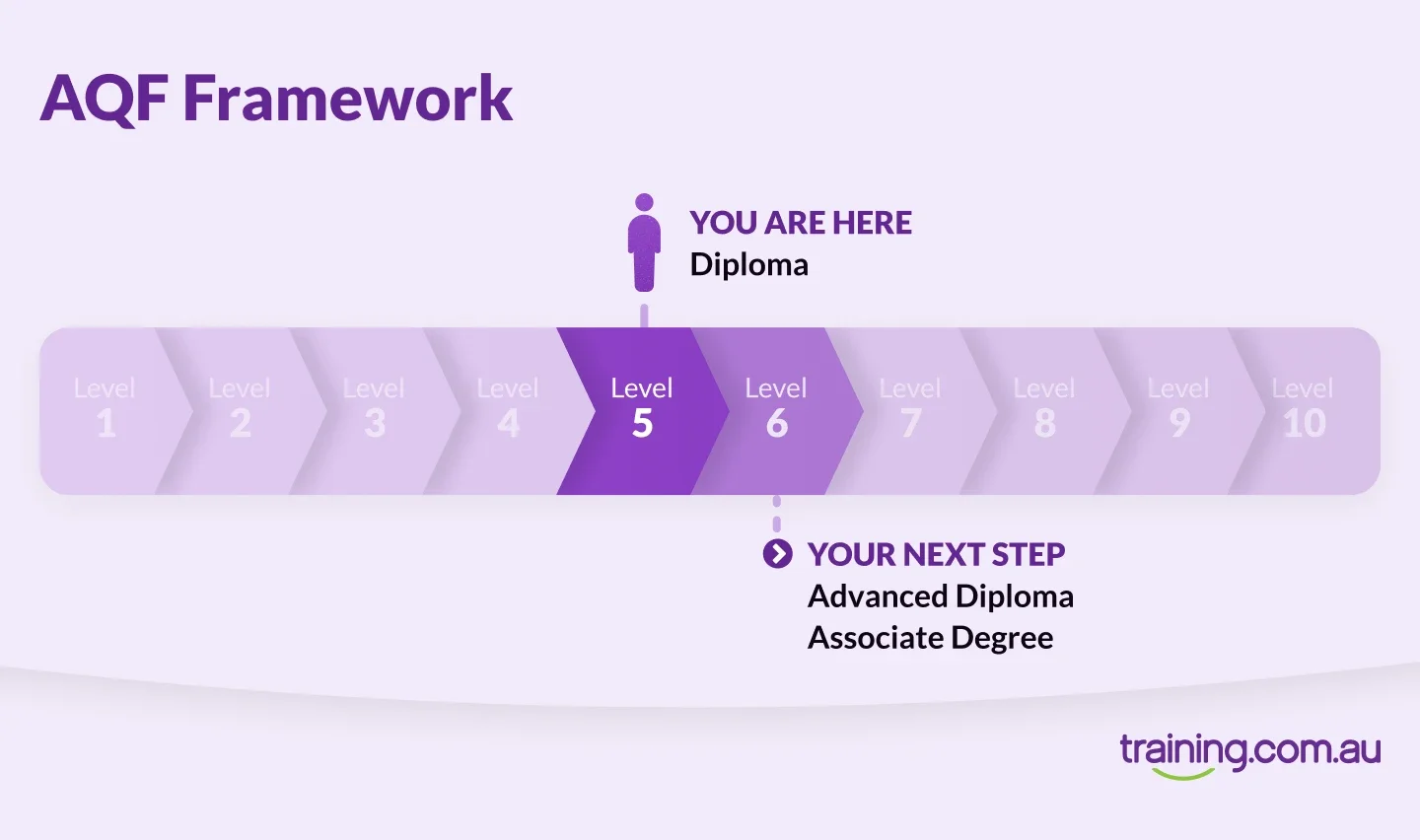
What’s the difference? (Diploma vs bachelor's degree)
Feature |
Diploma |
Bachelor Degree |
|---|---|---|
AQF Level |
Level 5 |
Level 7 |
Duration |
1–2 years |
3–4 years |
Skill Level |
Advanced vocational |
Advanced academic |
Focus |
Practical knowledge, industry-ready skills |
Theoretical depth, academic research |
Best For |
Fast-tracking employment, vocational qualification |
Professional careers or postgraduate study |
Pathways |
Credit into a bachelor’s or advanced diploma |
Entry into a master’s degree or professional roles |
Is a diploma worth it?
Choosing to study a diploma can be a smart investment in your future, offering a blend of practical skills, core skills, and industry knowledge that can set you apart in the job market. Diplomas are designed to prepare students for real-world challenges, making graduates more competitive and job-ready in their chosen study area.
Successfully completing a diploma can also open doors to further education, with many diplomas providing guaranteed entry into a university degree, such as a bachelor’s degree or even a master’s degree. This pathway allows you to earn credit for your completed studies, saving both time and money on your journey toward a higher qualification.
Diplomas are often more affordable and shorter in duration than full university degrees, making them a cost-effective way to gain a recognised qualification. They also offer the flexibility to explore different fields, such as business, marketing, the arts, or social science, before committing to a longer course of study.
No matter what your goals are, a diploma can be a valuable first step toward achieving them.
Take the first step toward your career
A diploma offers practical training, career flexibility, and a strong bridge to university degrees, including undergraduate and advanced diploma courses.
If you’re ready to explore flexible diploma courses, we have a range of courses to suit your goals. Gain a competitive edge in the workforce or progress confidently into further study.
Browse Results
Diploma of Building and Construction (Building) (VIC Only)
Tackle bigger and more rewarding challenges with our CPC50210 Diploma of Building and Construction (Building). If you feel you’re ready to tackle bigger and more rewarding challenges and start your own building business, then our Diploma building cours...
Certificate III in Community Services (Perth Only)
The Certificate III in Community Services is perfect for entry level community services workers who support individuals through the provision of person-centred services. Work may include day-to-day support of individuals in community settings or suppor...

Bachelor of Health Science (Clinical Nutrition)
Clinical nutritionists integrate traditional food wisdom and current scientific evidence to motivate individuals and communities to eat well and live healthier lives. The Bachelor of Health Science (Clinical Nutrition) is supported by a strong underpin...
Bachelor of Health Science (Naturopathy)
Naturopathy is a whole medical system combining theory (philosophy and principles) and practise that uses an array of natural therapies to support healing and maintain health. Naturopaths aim to treat the underlying causes of illness and disease. The c...
Certificate III in Individual Support (Ageing OR Disability) (Perth Only)
If you have a passion for helping those most in need, this qualification is one way you can utilise your knowledge for the benefit of others. Package the Certificate III in Individual Support (Ageing or Disability) (CHC33021) to save time and gain know...
Certificate III in Early Childhood Education & Care (Perth Only)
If you love working with children and want to learn more about providing quality education and care in a range of environments, this course is for you. The Certificate lll in Early Childhood Education and Care (CHC30121) can provide you with an entry-l...
Certificate III in Non-Emergency Patient Transport (VIC Only)
Our Promise We are confident in the delivery of our training. On successful completion of the course, graduates will be guaranteed a telephone interview for vacant Patient Transport Officer positions in the Non-Emergency Patient Transport division. So...
Diploma of Community Services (Perth Only)
The Diploma of Community Services qualification reflects the roles of community services, case management and social housing workers involved in the managing, co-ordinating and/or delivering of person-centred services to individuals, groups and communi...
Certificate III in School Based Education Support (Perth Only)
Are you interested in becoming a teacher’s aide? Work with teachers to create a comfortable and supportive environment for children’s learning. You will ensure lessons run smoothly while also developing the student’s literacy, numeracy and resear...
Certificate III in Allied Health Assistance (Perth Only)
A Certificate III in Allied Health is your entrance into the world of health services! This course will teach you to support workers in a range of fields such as audiology to social work. You will use your qualification to gain an entry-level job in ei...
Certificate III in Individual Support (Perth Only)
This qualification is for those who want to work in the community or in a residential setting, following a customised plan to give person-centred assistance to individuals who may need it due to ageing, disability or other circumstances. Work involves...
Bachelor of Health Science (Acupuncture Therapies)
Acupuncture is a branch of Chinese Medicine that stimulates specific points on the body to regulate the flow of Qi (vital energy) to restore health and balance the functions of the body, mind and spirit. Acupuncture therapies combines Chinese medicine...
Bachelor of Health Science (Chinese Medicine)
Chinese medicine is a whole medical system that seeks to balance the functions of the body, mind and spirit and restore health. It combines theory (philosophies and principles) and practices including acupuncture, moxibustion, medical Qi Gong, Chinese...
Diploma of Sustainable Operations
Looking to develop your skills to manage and measure your organisation’s carbon footprint? By studying this course, you will be equipped with the technical and theoretical skills to ensure your organisation is adhering and optimising its sustainability...
Certificate III in Community Pharmacy (Perth Only)
The SIR30116 Certificate III in Community Pharmacy prepares you for a rewarding career as a pharmacy assistant in a retail pharmacy setting. This course equips you with the skills to provide excellent customer service, assist with pharmacy products, an...

Certificate III in Individual Support (Perth Only)
The Certificate III in Individual Support equips students with the skills and knowledge to provide person-centred care to individuals in aged care, disability, or community settings. This course is ideal for those passionate about supporting people to...
People Leadership
Strengthen your leadership identity with this course, especially designed for senior managers who wish to create a positive influence on management and the organisation as a whole. Learn how to apply a ‘people perspective’ to decision-makin...
Bachelor of Cyber Security (VIC, NSW, QLD and WA Only)
The Bachelor of Cyber Security offered by AIBI Higher Education is a technical course designed to prepare students for entry-level roles leading to an exciting career in Cyber Security. Students will first learn the foundations of information technolog...

Certificate III in Early Childhood Education & Care (Perth Only)
To work in Early Childhood Education and Care you are required to have an Education and Care qualification. With our Certificate III in Early Childhood Education and Care qualification you will gain skills and knowledge to work in a range of early chil...
Certificate III in Fitness
This exciting course is the fitness industry’s entry-level qualification and it provides a thorough education on the human body, and the best & safest techniques for maximising its potential. With a Certificate III in Fitness you will gain the know...

Latest Articles


Want to read more?

