Thinking About a Career Change? Here's The Smartest Way To Do It


If you’re considering a major career change, you’re not alone. Many Australians are chasing more meaningful work, better work-life balance, or a bigger pay packet. Career transitions can feel daunting, but you don’t have to figure it out solo. We’re here to help you move forward with confidence and a clear plan.This guide gives you a practical framework for career changers at any stage, from weighing up your options to studying for your new career.
Take our free career quiz to find your career personality in minutes and get matched to roles that fit.
1. Why do you want to change careers?
Before you research roles or enrol in a course, answer one question: Why do you want to leave? Understanding your motivation gives you a reference point and helps when the process gets hard.
According to the University of Queensland, the average person changes jobs every 2 years and 9 months. Common drivers include wanting more meaningful work, escaping burnout in busy roles, or seeking better take-home pay. Others need work that fits around family life.
Self-assessment is the foundation for any career change, so it’s worth taking the time to be honest with yourself about your core values and genuine interests, and about what has actually energised you in past roles. Being good at something and being excited by it aren’t always the same thing. The clearer you are here, the easier it becomes to keep your whole career change on track.
It also helps to talk things through with someone you trust, whether that’s an honest chat with a colleague, mentor or career coach. A bit of objective guidance can help you spot blind spots you might never catch on your own. Once you’ve settled on a rough path, staying motivated tends to get a lot easier, and this new chapter starts to feel less like a risky leap and more like a plan you’re genuinely excited to follow.
2. Is the industry you want to move into the right fit?
Ambition alone doesn’t make a career plan. Before you commit to a direction, research your target industry. Use job websites to check role requirements, salary ranges, and in-demand skills. This works whether you’re eyeing business, community services, IT, or a trade, because the research process is the same.
Talk to people who already work in your target role. These informational interviews give you insight into daily tasks and can lead to opportunities that aren’t advertised. Industry events, professional groups, and LinkedIn are useful tools too. Treat them as ways to gather information, not just to network.
Your research should give you one clear figure: the realistic entry-level salary in your new field. Compare this to your current pay. Knowing your financial floor early stops you from making hasty decisions and keeps your planning grounded in reality.
3. What transferable skills do you have for a career change?
One common mistake career changers make is undervaluing what they already know. Your work experience has built skills that transfer across industries, including project management, communication, data analysis, stakeholder management and leadership.
To start identifying your transferable skills, list the core competencies you’ve built throughout your career, review job descriptions in your target area, and map your existing capabilities against what employers are seeking. This gap analysis shows exactly where your skills are strong and where you still have room to grow, and turns a vague plan into something specific and actionable.
4. Complete a career gap analysis
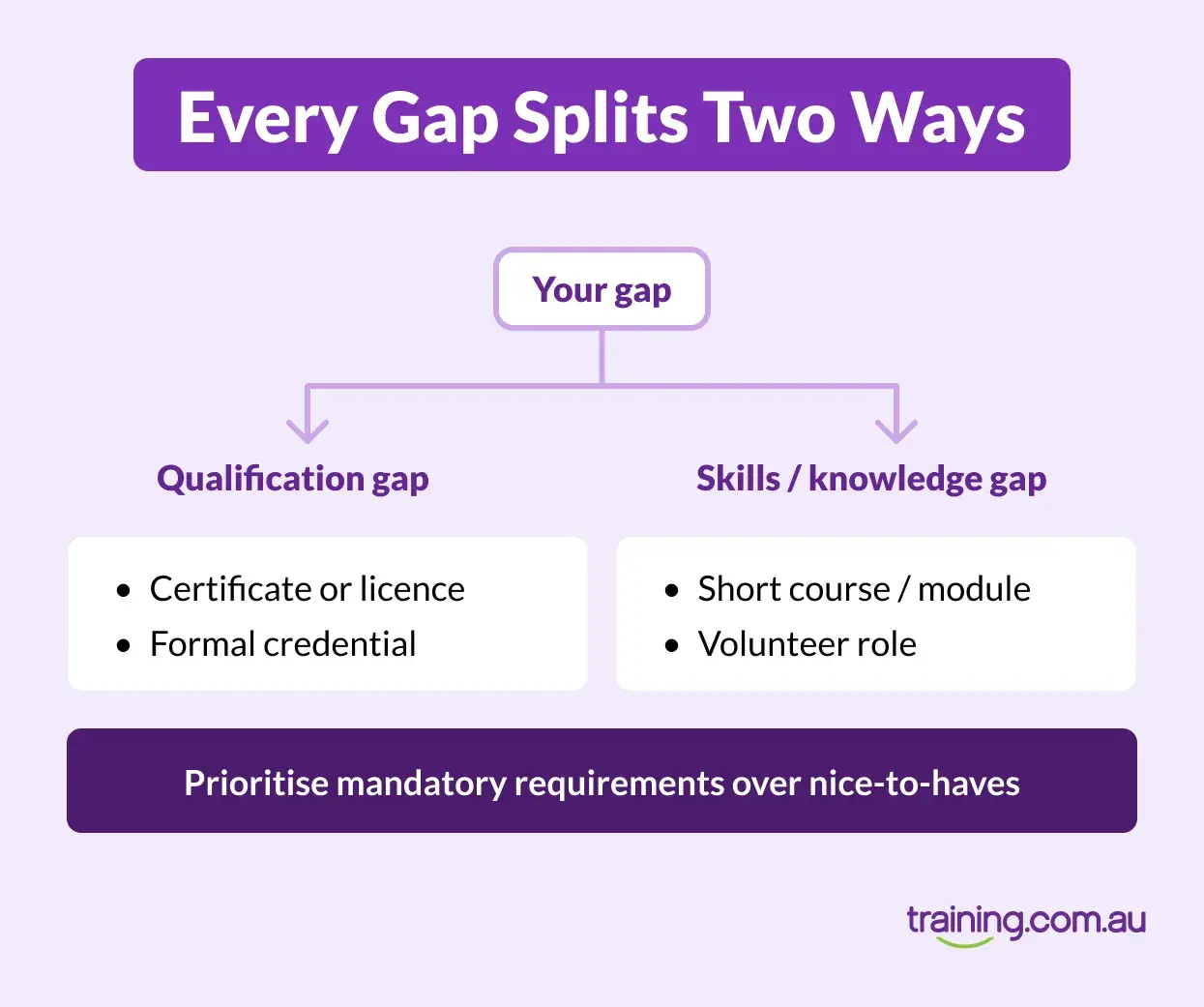
A gap analysis compares what you currently offer against what your target role actually requires. It turns a vague worry like “I’m not qualified enough” into a clear, actionable list you can work through one item at a time.
Step 1: Pull 5 to 10 job descriptions for your target role
Search Seek, LinkedIn and Indeed, and aim for a realistic entry or mid-level position rather than the most senior job you can find.
Step 2: Spot the requirements that keep repeating
The skills, qualifications and tools that show up again and again are the non-negotiables most employers expect.
Step 3: Match your current capabilities against that list
Rate yourself honestly on each one: strong, developing, or missing. Skills like project management, communication, data analysis and leadership transfer more widely than people expect.
Step 4: Sort what's missing into two categories
Qualifications are the certifications, licences or formal credentials the role requires. Skills and knowledge cover the tools, software or technical know-how you haven’t built yet.
Step 5: Match each gap to a solution
A qualification gap points to a specific course. A skills gap might close faster through a short course, an online module, a volunteer role or a side project.
Step 6: Prioritise by what employers actually weight
A missing mandatory licence matters more than a missing “nice to have” tool, so put your energy into the essentials first, not the preferences.
Turn this into a simple table mapping each requirement against where you currently stand. That’s what makes the process concrete instead of vague.
The real output of a gap analysis isn’t a list of what you lack. It’s a clear, prioritised roadmap from where you are to where you want to be.
5. What qualifications do you need to change careers?
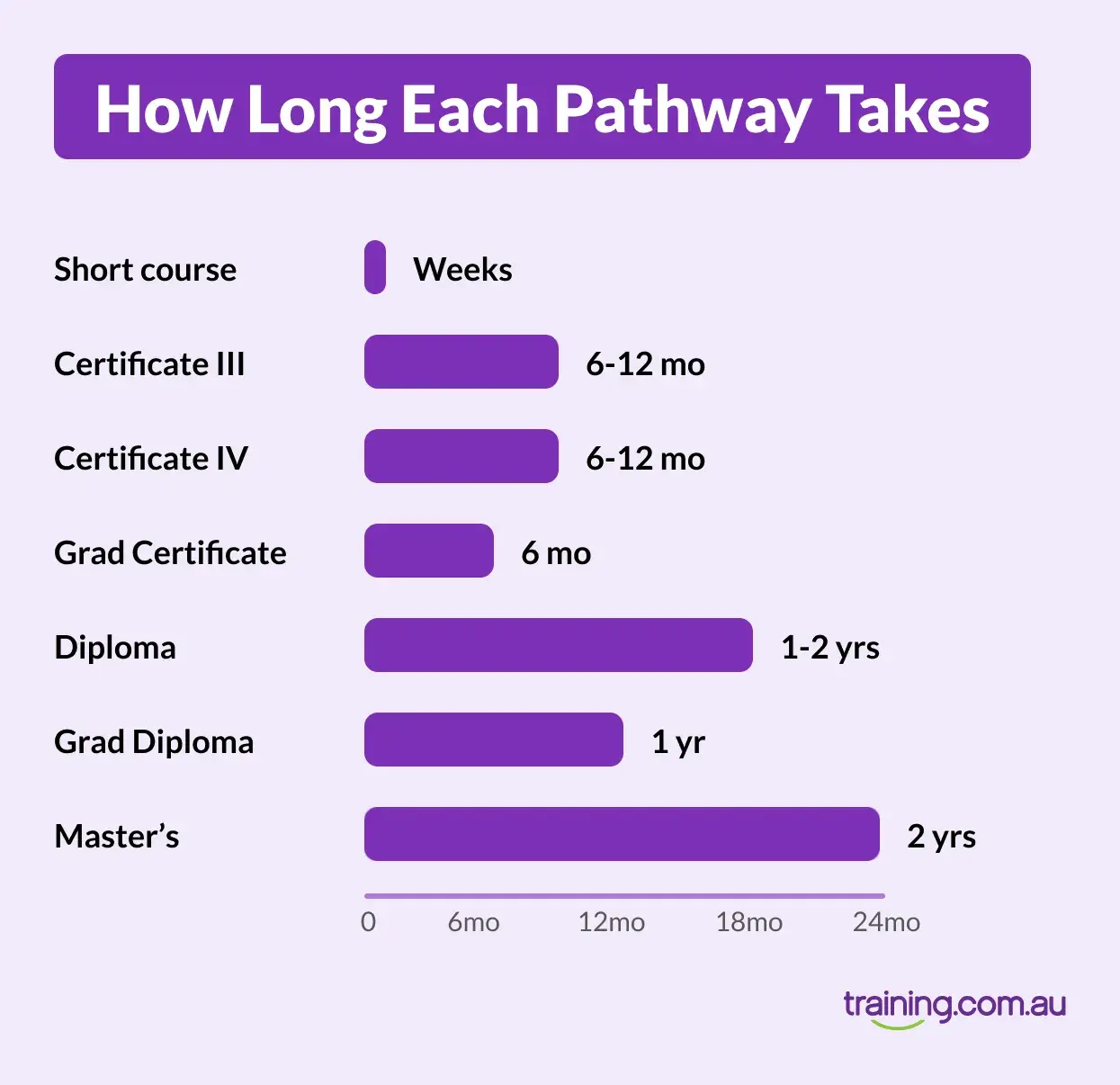
Once you know your gaps, the next step is closing them. For many career changes, a single short course or certificate is enough to prove your skills, no full degree pathway required.
Course options
Short courses
Build a targeted skill in a matter of weeks. Short courses fit around full-time work, making them the lowest-risk way to enter a new industry or role.
Certificate III
The standard entry-level qualification for trades and service roles across Australia. It builds job-ready skills that employers recognise and hiring managers expect.
Certificate IV
A nationally recognised credential that prepares you for advanced or supervisory roles by validating what you can already do.
Diploma
Comprehensive training in a specialised field, usually completed in one to two years. It’s the practical choice for a significant career move, giving you a solid grounding in your target industry.
Graduate certificate
A focused six-month qualification for degree-holders pivoting into a related field. It offers specialist knowledge without the commitment of a longer program.
Graduate diploma
Completed in about one year, a Graduate Diploma goes deeper than a Graduate Certificate. It suits roles where demonstrated expertise in a specific discipline is a baseline requirement.
Master's degree
The qualification of choice for senior or specialist roles. Completed in about two years, it provides the credentials and depth needed to compete at the highest level in a new field.
What is Recognition of Prior Learning, and how does it help?
If you have solid work experience, Recognition of Prior Learning (RPL) can recognise your existing skills and knowledge towards a formal qualification, cutting down the time and cost of study.
6. How do you manage the risks of changing careers?
Changing careers brings real challenges: financial pressure, uncertainty, and the difficulty of juggling transition work with a full-time job and personal commitments. Acknowledging these realities is the foundation of good planning.
Financial risk
- Before leaving your job, build a buffer of three to six months’ living costs.
- Know your income floor, the minimum take-home pay your situation requires.
- Avoid irreversible decisions until that buffer is in place.
Career inertia
Many people feel stuck in a job for months, even years, while wanting change. The fix isn’t motivation. It’s structure.
Break the change into small, clear steps. Each one builds momentum, and you don’t need to quit your job or lose your income overnight.
Define your non-negotiables early
Remote work, hours, salary and industry all matter. Let them guide which jobs you pursue. A career change isn’t a chance to fix every problem at once. It’s a focused move towards work that fits you better.
Action over analysis
Research matters, but too much of it becomes a trap. The top reason career changes stall isn’t a lack of information. It’s a lack of action.
Enrol in a course. Reach out to someone in your target field. Arrange a job shadow. Small steps like these drive real progress. Research alone doesn’t.
One chat or one short course can open doors you didn’t expect. Move step by step rather than waiting for the perfect moment. This gives you a clearer sense of what’s next, and keeps you flexible if your plans change.
Taking action before you feel ready isn’t reckless. It’s how you build confidence.
Success in a career change isn’t one big decision. It’s small, steady steps: check your skills, build your network, do the right training. Keep moving, even when it feels slow.
Frequently Asked Questions
What are the most common reasons people change careers?
The most common reasons are better work-life balance and more meaningful work. This is especially true for people in busy roles like teaching or nursing. Higher pay is another big driver.
How do I know what career to change to?
Start by identifying your core values, interests, and the skills that energise you. A career aptitude test, like our free career quiz, can help by matching your career personality to real job data. From there, research target roles through job ads and informational interviews.
Can I change careers while working full-time?
Yes. Most successful career changers make the change while still employed. Break it into steps: research, networking, short courses or part-time study, and building a financial buffer before resigning.
How long does it take to change careers?
It depends on your qualification gap. A short course can take just weeks. A Certificate III or IV usually takes six to twelve months, while a Diploma can take up to two years. Recognition of Prior Learning can shorten these timeframes by crediting your existing experience.
Are accredited courses enough to change careers?
For most changes, yes. Accredited courses are designed to be job-ready. They’re usually faster and cheaper than a university degree.
What is recognition of prior learning and how does it help career changers?
RPL is a formal process that recognises your existing skills and experience towards a nationally recognised qualification. It can reduce the time and cost of study and, in some cases, fast-track you straight to the units you still need.
What transferable skills matter most when switching careers?
Skills such as project management, communication, data analysis, and leadership transfer across almost every industry. Identify which of these you already have. Show them clearly on your resume. It’s one of the best ways to enter a new field without direct experience.
Start your own career change with confidence
A career change isn’t a gamble. It’s a structured move, backed by the right knowledge, qualifications and a clear plan.
At training.com.au, we connect ambitious professionals with accredited courses from trusted providers across every major industry. Ready to build new skills for your career change? Start exploring courses today.
Not sure which direction suits you best, or which professional community you’d thrive in? Take our free career quiz to discover your career personality, or browse all courses to start planning your move.

Latest Articles


Want to read more?
Discover the most in-demand jobs in Australia for each industry, so you can pick a resilient and high-growth field — and secure your future.

When it comes to gender equality in the workplace, we’ve come a long way since the 1950s. Or have we? In the Australian workforce, gender discrimination is still rife, men dominate the top jobs, and the pay gap leaves women with less money and opportunity. So what’s changing, and what else can be done?

Got an aged care job interview lined up? Learn how to prepare and show the hiring manager you're a great fit for the role.
