10 IT Certifications Worth Your Time (and Money)


Certifications don’t replace experience, but they do open doors. If you want to level up, switch tracks, or you’re just sick of winging it, the right credential can show you’ve got current, job-ready skills.
In Australia’s tech market, where demand outweighs supply, a certification is more than a résumé filler. It’s proof you can walk the walk. Here are ten IT certifications that matter, depending on where you are and where you’re heading.
Why IT certifications matter (more than ever)
Tech doesn’t sit still. What you learned two years ago might be collecting dust now. Certifications help validate your current technical skills, demonstrate to hiring managers that you’re serious about professional development, and often open doors to better-paying roles.
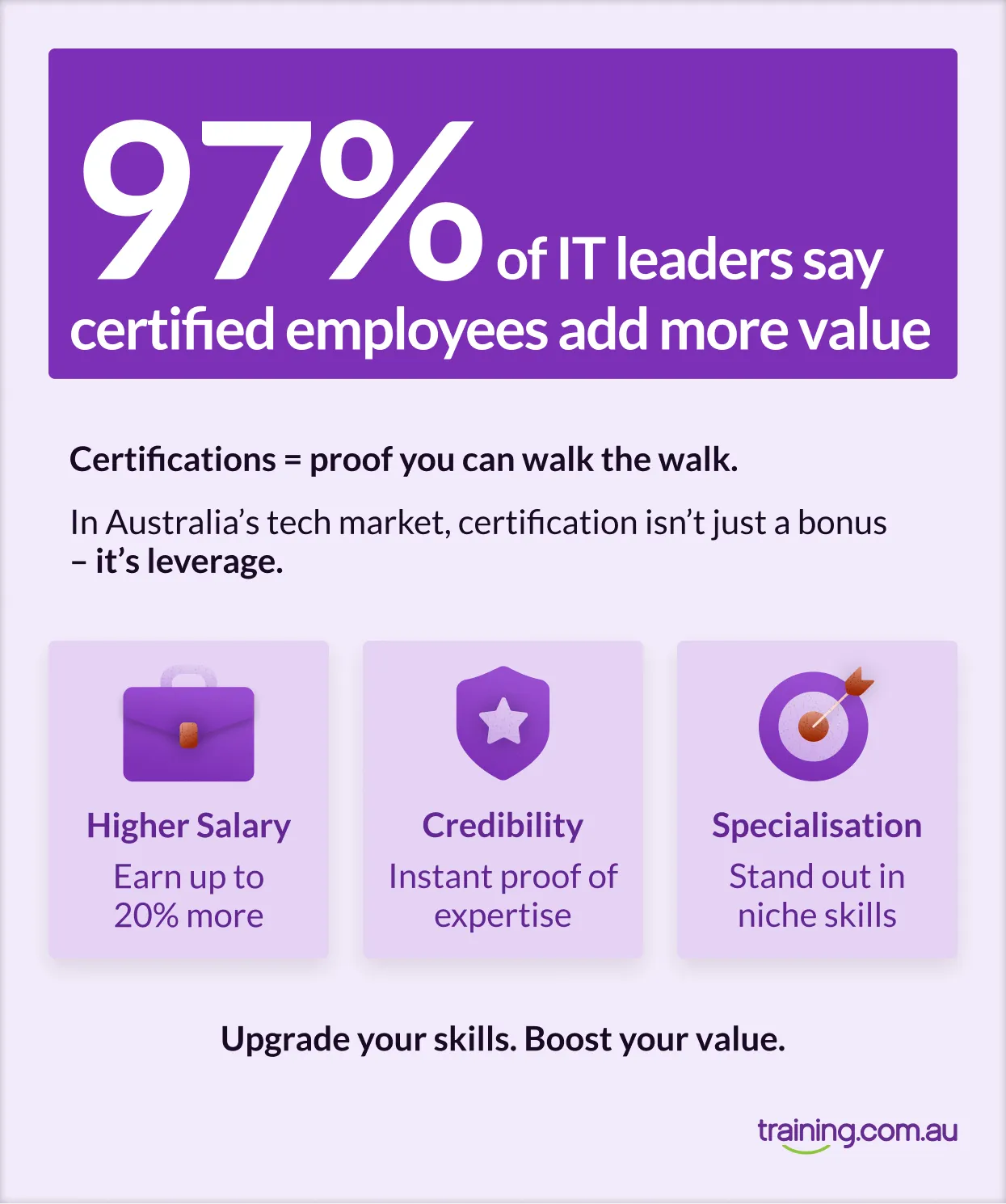
According to Global Knowledge, 97% of IT leaders say that certified employees add more value to their organisation than non-certified employees. They also add weight when you’re applying for roles needing specific expertise, like cybersecurity analyst, systems administrator, or cloud computing roles.
Top 10 IT certifications that benefit your career
Certifications are a shortcut to credibility. These are the credentials hiring managers care about, especially in high-demand roles across cloud computing, cybersecurity, and IT operations.
1. CompTIA A+
- Type: Vendor-neutral certification
- Best for: Entry-level IT roles, career changers
- Covers: Operating systems, hardware, troubleshooting, networking basics, risk management
- Why it matters: A foundational certification that’s widely accepted across IT support and helpdesk environments. It’s also part of the broader family of CompTIA certifications, seen as the gold standard for entry-level professionals.
- Ideal for: Service desk analysts, technical support, junior systems administrators
This is often your entry point into the tech industry. It covers certification exams focused on core hardware/software knowledge and validates technical skills that align well with job market needs.
2. AWS Certified Solutions Architect – Associate
- Type: Professional certification (AWS certified)
- Best for: Cloud engineers, DevOps professionals, systems administrators
- Covers: Enterprise solutions, AWS services, network security, identity and access management, cost optimisation
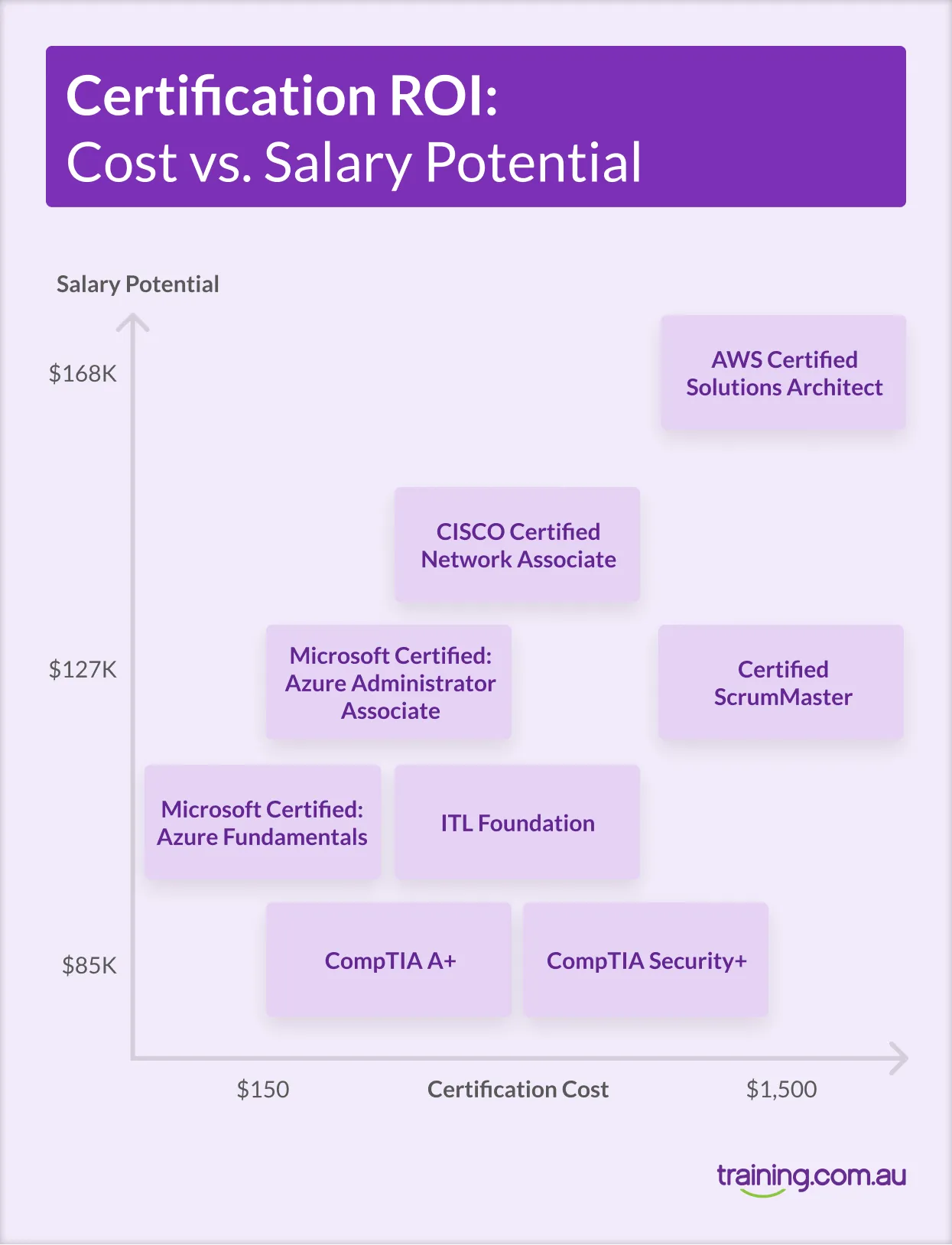
- Why it matters: This credential proves you’re ready to design resilient and scalable architectures in AWS. Cloud certifications are in high demand across Australia, and this one opens doors to six-figure cloud engineer roles.
- Ideal for: Mid-level professionals shifting toward cloud platform specialisation
If you’re aiming to build a cloud career path, this certification delivers practical, hands-on experience that aligns with real-world infrastructure demands.
3. Cisco Certified Network Associate (CCNA)
- Type: Industry-recognised certification
- Best for: Network administrators, network engineers
- Covers: IP connectivity, network security, routing and switching, IT infrastructure fundamentals
- Why it matters: It is one of the most respected certifications for anyone working on enterprise-grade networks. The CCNA validates your understanding of Cisco-certified network design and configuration practices.
- Ideal for: Network engineers, infrastructure teams, security administrators
This is a core stepping stone if you’re eyeing a systems administrator or network engineer trajectory.
4. Microsoft Certified: Azure Fundamentals
- Type: Foundational certification (Microsoft certified)
- Best for: Beginners exploring cloud computing
- Covers: Cloud concepts, Azure pricing, governance, and architecture basics
- Why it matters: Azure is a dominant force in cloud computing. This is a low-barrier cert that builds your cloud vocabulary and demonstrates technical curiosity to hiring managers.
- Ideal for: IT sales, pre-sales engineers, aspiring cloud professionals
It also preps you for more technical Azure certs like the Azure Administrator or Azure Developer Associate.
5. Google Associate Cloud Engineer
- Type: Associate-level certification
- Best for: Junior cloud engineers, DevOps beginners
- Covers: Google Cloud Platform (GCP), cloud deployment, operations, monitoring, IAM
- Why it matters: Google Cloud is growing rapidly. This certification demonstrates hands-on experience with real cloud platform tools and automation.
- Ideal for: Professionals focused on cloud computing, cloud security, or platform ops
Google’s certifications are becoming more competitive in hiring pipelines, especially in hybrid-cloud environments.
6. CompTIA Security+
- Type: Vendor-neutral certification
- Best for: Cybersecurity analysts, compliance and security administrators
- Covers: Network security, incident management, threat detection, risk management
- Why it matters: Recognised globally, and ISO 17024-compliant. It’s often a baseline requirement for security roles.
- Ideal for: Security operations, governance roles, junior cyber roles
This certification helps establish your position in the cybersecurity certification track and builds credibility across regulated industries.
7. Certified ScrumMaster (CSM)
- Type: Professional certification
- Best for: Agile project managers, business analysts, team leads
- Covers: Agile frameworks, Scrum roles/events/artifacts, sprint planning
- Why it matters: In agile environments, Scrum certifications show you understand iterative delivery, backlog grooming, and cross-functional team facilitation.
- Ideal for: Product owners, delivery managers, software development leads
While not deeply technical, it aligns well with project management and agile delivery roles.
8. Google IT Support Certificate
- Type: Entry-level certification
- Best for: Career changers, early-stage professionals
- Covers: Troubleshooting, customer service, systems administration, Linux basics
- Why it matters: One of the most accessible ways to break into tech. It’s an online, short-course-based certification backed by Google.
- Ideal for: Desktop support, service desk, and technical assistant roles
Great for anyone needing a quick transition into the tech world without committing to a degree.
9. ITIL Foundation
- Type: Vendor-neutral certification
- Best for: IT service managers, operations teams
- Covers: IT service lifecycle, change management, business-aligned IT strategies
- Why it matters: ITIL helps professionals improve internal workflows, reliability, and incident management across service teams.
- Ideal for: Ops analysts, service delivery managers, internal IT teams
If you’re managing internal support platforms or service delivery SLAs, this certification pays off.
10. Microsoft Certified: Azure Administrator Associate
- Type: Intermediate Microsoft certification
- Best for: Cloud administrators, mid-level IT professionals
- Covers: Azure resource deployment, storage, compute, virtual networks, and governance
- Why it matters: It proves you can manage cloud workloads at scale. Critical for organisations running Microsoft-centric infrastructures.
- Ideal for: DevOps engineers, infrastructure specialists, systems administrators with Azure exposure
Hands-on experience is key for this one—it’s not just multiple choice. You’ll need to know how to configure and monitor in live environments.
Which certification makes sense for you?
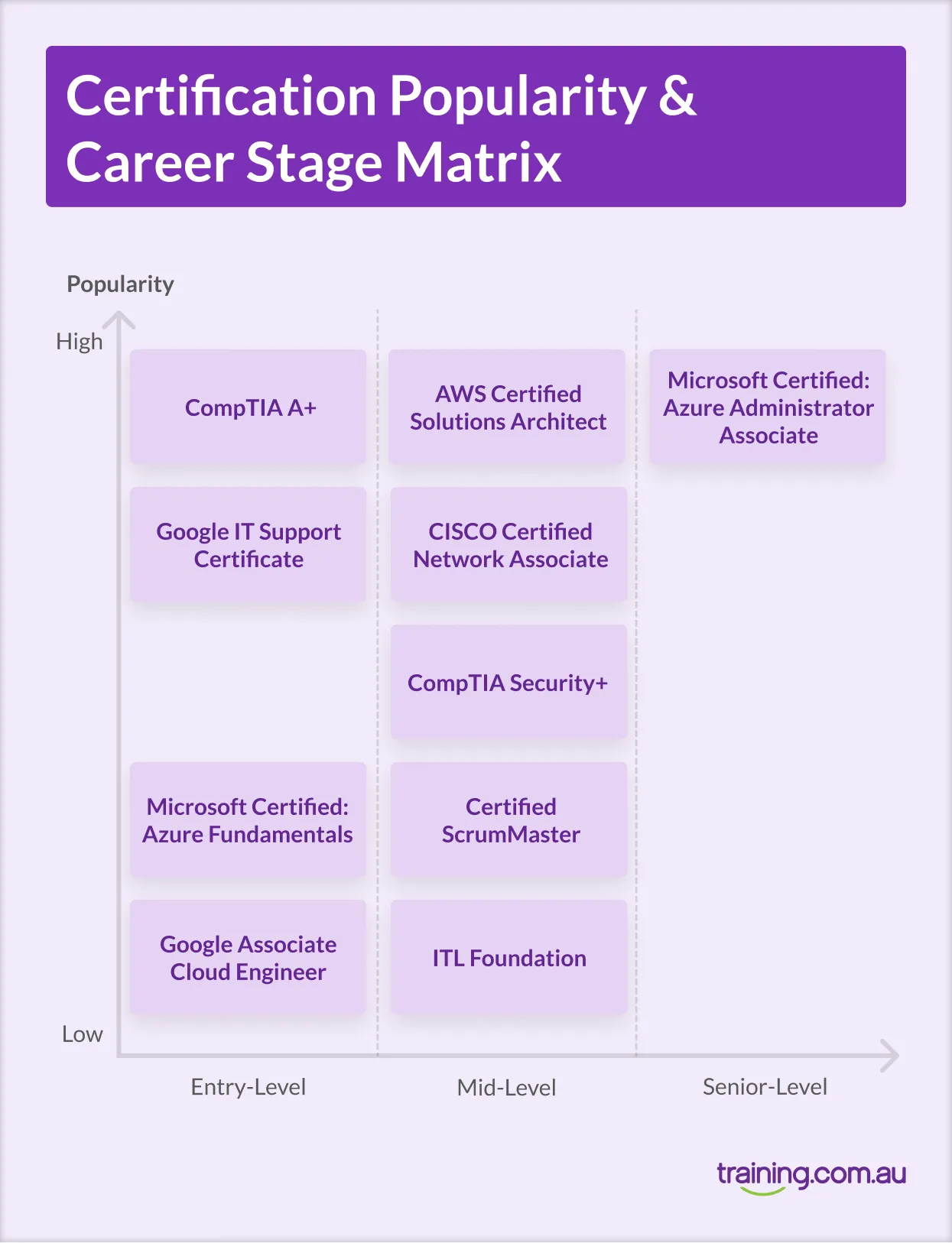
Start by looking at your current position, including your role, skill gaps, and where you want to land. Then cross-reference that with job listings in your target space. Which certifications keep showing up? Which tools and platforms are non-negotiable? That’s your shortlist.
If you’re new to IT, foundational certs like CompTIA A+ or Google’s IT Support Certificate can help you get oriented. Already working with cloud infrastructure? AWS Solutions Architect or Microsoft Azure Administrator Associate will put you in range of better roles and more strategic work.
Shifting lanes into cybersecurity, networking, or project delivery? There’s a cert track for each industry-standard, well-recognised, and designed to fast-track credibility.
Final note
You don’t always need a computer science degree or a decade in ops to move forward. Most certs are self-paced, online, and built for people who have lives outside tech.
Certs won’t land the job for you. But they do close the gap between where you are and where you’re aiming. Choose deliberately. Put in the hours. Build capability.
And the rest will follow.

Your IT career starts here
Starting from scratch? Discover the skills, pathways, and opportunities to start working in tech with confidence in our guide.
Browse Results








Latest Articles


Want to read more?

A quality sample of a cover letter for retail. Learn what to include in your cover letter to help employers recognise your value.

